
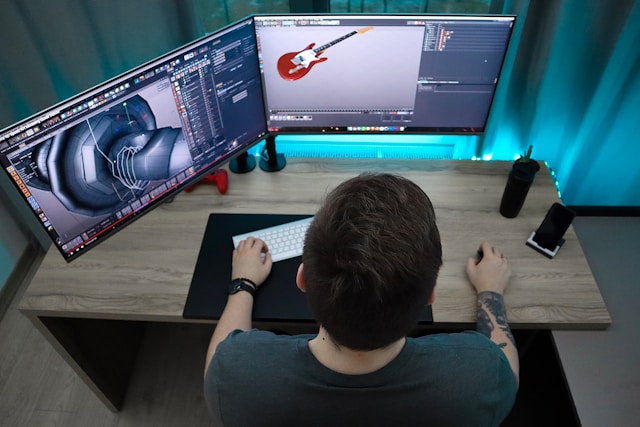
What Is 3D Animation?
At its core, 3D animation is the illusion of movement within a three-dimensional digital space. Unlike 2D animation, which manipulates flat drawings, 3D animation works with depth—objects occupy volume and interact with light, physics, and texture. Modern 3D animation blends art and engineering, imagination and algorithms.
Every moving frame is a product of modeling, rigging, lighting, simulation, and rendering. Each of these stages requires both precision and creativity, because animation isn’t just motion—it’s emotion rendered in pixels.
Types of 3D Animation You’ll Encounter
Not all 3D animation is built the same. Different goals demand different techniques, from stylized loops to cinematic realism.
| Type | Purpose | Used In | Example |
|---|---|---|---|
| Character Animation | Brings digital characters to life with personality and emotion | Film, games, advertising | Toy Story, Spider-Man: Into the Spider-Verse |
| Motion Graphics | Visual storytelling using animated shapes, text, and symbols | Brand videos, explainers, UX | Apple product ads |
| Simulation Animation | Replicates real-world physics like fire, water, or cloth | VFX, film, visualization | Frozen II snow effects |
| Procedural Animation | Uses algorithms to automate complex motion | Open-world games, crowd scenes | Assassin’s Creed series |
| Stop-Motion 3D Hybrid | Combines physical models with 3D enhancements | Film, indie projects | Kubo and the Two Strings |
Why 3D Animation Matters
3D animation bridges logic and feeling. It lets artists simulate physics while shaping fantasy. It’s how filmmakers make us believe toys can talk or astronauts can cry in zero gravity. From Pixar’s human warmth to game cinematics in Unreal Engine, 3D animation creates a suspension of disbelief powerful enough to make pixels feel sentient.
How the 3D Animation Pipeline Works
Creating an animation isn’t a single act—it’s a sequence of stages that demand coordination across departments. Here’s how the typical pipeline looks:
| Stage | Key Tasks | Tools Often Used |
|---|---|---|
| Modeling | Building 3D objects, characters, and environments | Blender, Maya, ZBrush |
| Rigging | Creating skeletons and control systems for movement | Maya, 3ds Max |
| Animation | Setting keyframes and refining timing, arcs, and poses | Maya, Blender, Cinema 4D |
| Lighting & Rendering | Applying textures, light simulation, and final visuals | Arnold, Redshift, Unreal Engine |
| Compositing | Combining 3D passes and post-processing effects | After Effects, Nuke, DaVinci Resolve |
Famous 3D Animation Examples
Here are some standout examples that show what’s possible when art, code, and timing align:
- Pixar’s “Soul”: A blend of stylized metaphysics and ultra-real lighting that redefines visual storytelling.
- Love, Death + Robots: An anthology proving that 3D animation can be painterly, abstract, or photo-real—all in one show.
- Arcane (Riot Games): Hand-painted textures fused with 3D depth, setting a new benchmark for hybrid animation style.
- Spider-Man: Into the Spider-Verse: Comic-book aesthetics mixed with 3D physics and hand-drawn timing.
- Blender Studio’s “Sprite Fright”: A fully open-source production showing the capability of community-driven pipelines.
Game Animation: Where Control Meets Emotion
Games bring an extra challenge: the player controls timing. Animations must loop seamlessly, react in real time, and still feel expressive. Studios like Naughty Dog and Guerrilla Games spend years developing motion systems that merge cinematic quality with gameplay responsiveness.
Techniques That Bring 3D Animation to Life
- Keyframe Animation: The classic technique—artists manually set poses frame by frame.
- Motion Capture: Captures real actors’ movements to drive 3D rigs, used in everything from sports games to films.
- Physics Simulation: Adds realism to fabrics, liquids, and destruction sequences.
- Procedural Systems: Algorithmic motion generation for large-scale or dynamic environments.
Each technique carries its own personality: keyframe animation is poetic; mocap is grounded; simulation is scientific. Great animators know when to mix them.
Tools of the Trade
- Modeling & Rigging: Blender, Maya, ZBrush
- Animation: Autodesk Maya, Blender, Cinema 4D
- Rendering: Unreal Engine, Redshift, Arnold
- Compositing: After Effects, Nuke
- Game Engines: Unity, Unreal Engine 5
Challenges Every Animator Faces
Even experienced artists struggle with timing, weight, and believability. The hardest part isn’t making things move—it’s making them feel alive. A subtle delay, a blink, a breath—those micro-moments separate lifeless motion from personality.
Why 3D Animation Is an Evolving Art Form
From early CGI in “Jurassic Park” to the real-time wonders of Unreal Engine 5, 3D animation keeps redefining how we visualize imagination. It’s not just a tool—it’s a language in motion, where physics meets poetry.
Final Thoughts: The Power of Movement
Animation, at its heart, is empathy through motion. Whether you’re watching a short indie film or building your own 3D game scene, the goal is the same—to make digital worlds breathe. Study great 3D animation examples, experiment with timing, and trust your artistic instincts. Every frame you polish brings you closer to mastering the illusion of life.
Author’s Note (E-E-A-T Transparency): Written by a 3D animation professional with experience in cinematic pipelines, real-time engines, and character motion design. The insights shared here reflect practical experience in both studio and freelance environments.